
The headline numbers tell their own story
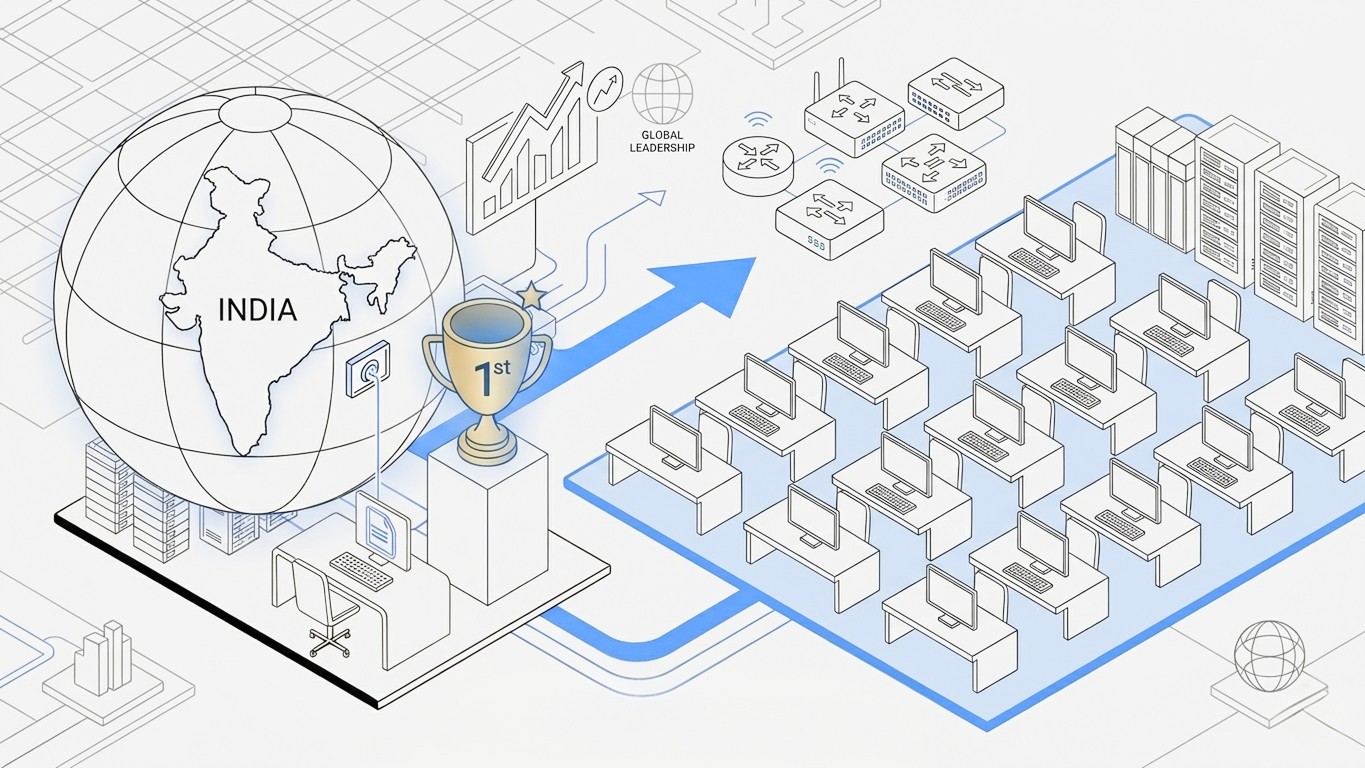
India accounts for roughly 56 percent of the global sourcing market and nearly 40 percent of global sourcing spend. The Indian IT-BPM industry crossed 224 billion dollars in exports in FY25, growing over 12 percent year on year. The BPM segment alone is a 44 billion dollar business and still growing in double digits.
The United States and the United Kingdom together absorb close to 80 percent of those exports. The industry employs millions, contributes around 10 percent of India's GDP, and is on track to double in size to half a trillion dollars by 2030.
These aren't accidental numbers. They're the result of a structural advantage that has compounded over thirty years, and the reason why partnering with a BPM solutions company in India remains one of the most strategically sound decisions a global enterprise can make.
Why India still leads: talent, technology, trust, scale, language, cost, and timing
Here's what that really means in practice.
1. A talent pool no other geography can match
India produces more than 1.5 million STEM graduates every year. The BPM industry alone employs over a million professionals, with millions more in adjacent fields. This isn't just a headcount. It's a layered talent pipeline of fresh graduates, mid-career specialists, and seasoned domain experts, all available at scale and ready to deploy.
When an enterprise needs to ramp 500 trained associates in three weeks, a BPM services company in India is one of the very few places on earth where that's a phone call, not a six-month hiring strategy.
2. Tier 2 and Tier 3 cities are the new growth engine
The story has moved well beyond Bengaluru and Gurgaon. In 2025, non-metro cities like Udaipur, Vizag, Coimbatore, Nagpur, Bhubaneswar, and Indore drove more than 50 percent of IT hiring growth in India. Tier 2 and Tier 3 hubs now offer around 30 percent cost savings versus metros, with lower attrition, better workforce stability, and access to large untapped talent pools.
For any BPM solutions company in India, this is a game changer. It means enterprises can scale up without paying metro prices, and delivery networks can be built to be both cost-efficient and resilient.
3. English at scale, plus 20+ other Indian languages
India remains the largest English-speaking workforce outside the US. But the real edge today is multilingual delivery. Enterprises serving Indian customers, or global customers with regional preferences, need delivery in Hindi, Tamil, Telugu, Bengali, Marathi, Kannada, Malayalam, Punjabi, Odia, Gujarati, and more. A managed services company in India has all of it, under one roof, in one country.
That's hard to replicate anywhere else.
4. A real time zone advantage
India sits in a sweet spot between the US and Europe. It can serve North American clients overnight, European clients during their working day, and APAC clients in real time. For 24x7 support operations, that single geographic fact removes a whole category of operational complexity.
5. From cost arbitrage to capability arbitrage
The old narrative was simple. India was cheap. That narrative is now outdated. The new narrative is more interesting.
Yes, costs remain competitive. But India today is competing on capability. AI-enabled platforms, automated quality monitoring, sentiment intelligence, omnichannel delivery, and analytics-driven CX are now embedded in how leading BPM services companies in India operate. They're no longer just running operations. They're building the systems that power them.
In FY25, the industry recorded 16 percent year on year growth in IT hiring, driven specifically by AI adoption, cloud modernisation, and the rapid expansion of Global Capability Centres. The centre of gravity has shifted from "send us your work" to "let us solve the problem better than you can in-house."
6. Decades of process maturity
India didn't just learn outsourcing. It standardised it. ISO and SOC certifications, mature quality frameworks, robust governance models, structured training engines, and audit-ready compliance practices are now table stakes. Three decades of serving Fortune 500 clients has produced a level of process discipline that newer outsourcing companies in India geographies are still building.
This matters because at enterprise scale, predictability beats price. A BPM services company that misses SLAs costs you far more than the savings on paper.
7. A favourable policy and infrastructure tailwind
Initiatives like Digital India, Software Technology Parks of India, the National AI Mission with its 38,000 GPUs, and consistent FDI inflows into the IT and BPM sector have created an ecosystem where BPM solutions companies in India can invest in technology, infrastructure, and talent with confidence.
When government, industry, and capital align this consistently for this long, a structural advantage emerges that is very difficult to displace.
What's changing inside the industry
The Indian BPM industry of 2026 looks very different from the call-centre image of the early 2000s. A few important shifts worth noting.
AI is now an operating layer, not a differentiator. Sentiment analysis, automated QA, real-time agent assist, and conversational platforms are embedded in everyday delivery across leading BPM services companies.
Customer experience has overtaken cost as the primary KPI. NPS, CSAT, and lifetime value now sit alongside cost per transaction in every serious client conversation.
GCCs are reshaping the landscape. Global enterprises are setting up their own delivery centres in India, often partnering with a local managed services company in India for scale, talent, and technology integration.
The work is moving up the value chain. Voice and email support is now joined by analytics, RPA, finance and accounting, revenue cycle management, and complex domain-specific processes.
Outcome-based contracts are the new norm. Clients want measurable business impact, not billable hours.
What it means for global enterprises
If you're a CXO at a US, UK, or European enterprise weighing your outsourcing options, the calculation has changed.
You're not just buying cost savings anymore. You're buying access to a deep, technology-enabled talent ecosystem through a BPM services company with proven delivery at scale.
You can scale, contract, or pivot without the fixed costs of building your own operation.
You can run truly 24x7 operations without juggling three regional teams across multiple geographies.
You can enter India as a market while serving it from India as a hub for one country, dual purpose.
None of this is theoretical. It's how the world's most successful enterprises are already operating through their outsourcing company in India partnerships.
The bottom line
India's leadership in the global BPM industry isn't an accident, and it isn't a phase. It's the result of three decades of compounding advantage — talent, technology, language, time zones, process discipline, and policy support all pulling in the same direction.
For any global enterprise in 2026, the question isn't whether to engage with a BPM services company in India. It's how to choose the right one, and how to structure the partnership for maximum strategic value.
Looking to tap into India's BPM advantage?
Partner with a leading Indian BPM service provider that combines proven scale with modern AI-led delivery.
" transform="translate(14.43 5.93)" width="6.07px"/><path d="M 0 0 L 16.83 0" fill="transparent" height="1px" id="MMjyZF7WG" stroke-dasharray="" stroke-linecap="round" stroke-linejoin="round" stroke-width="1.5" stroke="rgb(255, 255, 255)" transform="translate(3.5 12)" width="16.83px"/></svg>)