
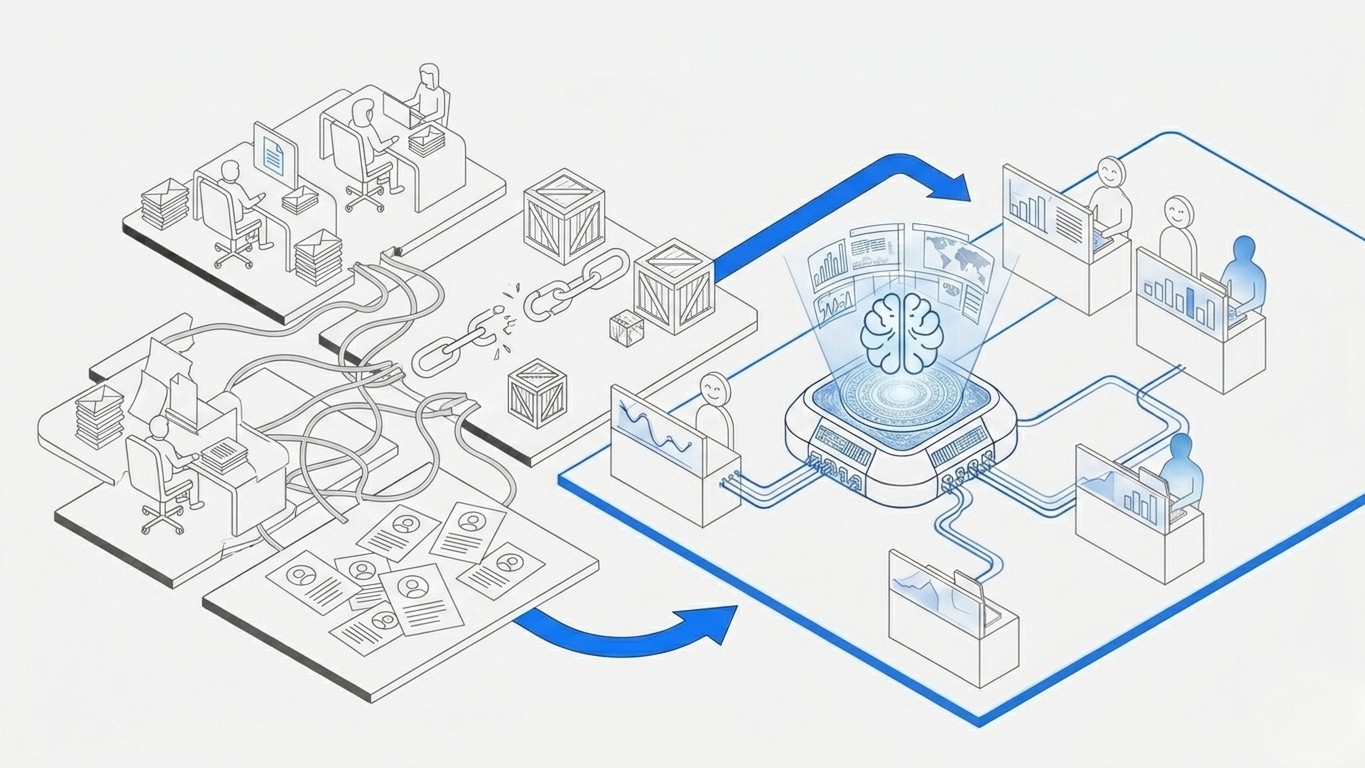
The fragmented outsourcing model is showing its limits
For years, the default approach was to outsource selectively. One vendor for customer service. Another for collections. A third for back-office processing. Each managed separately, each optimised in isolation, each carrying its own governance overhead.
The problems with this model compound over time. Data sits in silos. Handoffs between vendors create friction and finger-pointing. Leadership spends time managing multiple relationships instead of managing outcomes. And the customer experience, which cuts across every one of these functions, suffers because no single outsourcing partner for enterprises owns it end to end.
The fragmented model made sense when outsourcing was primarily a cost decision. It makes far less sense when outsourcing is a growth decision.
What end-to-end outsourcing actually means
End-to-end outsourcing means partnering with a single outsourcing partner for enterprises that takes ownership of the full customer and operational lifecycle, not just individual functions within it.
In practice, this means one partner managing:
Customer acquisition and onboarding
Omnichannel customer experience and support
Collections and revenue recovery
Back-office processing and data management
Quality assurance, analytics, and continuous improvement
Technology integration and performance reporting
The result is a single governance model, a single accountability framework, and a single line of sight from input to outcome. That is what business process outsourcing services at full scale looks like when it is done well.
Five reasons enterprises are making the shift
1. One partner, one version of the truth
When multiple vendors own different parts of the customer journey, data consistency becomes a chronic problem. Customer records, interaction histories, feedback signals, and performance metrics all live in different systems with different definitions.
A single outsourcing partner for enterprises running end-to-end operations creates one unified data layer. Leadership gets a clean, consistent view of what is happening across the entire operation, not a patchwork of vendor reports that never quite reconcile.
2. Seamless customer experience across every touchpoint
Customers do not experience your business as a set of separate functions. They experience it as one continuous relationship. When acquisition, onboarding, servicing, and collections are all managed by different providers, the joins show.
End-to-end business process outsourcing services remove those joins. The same quality standards, the same tone, the same service philosophy applied consistently across every interaction, every channel, every stage of the customer lifecycle.
3. Faster problem resolution and root cause ownership
In a fragmented outsourcing model, identifying the root cause of a customer experience problem often means navigating between vendors, each of whom has visibility of only their part of the journey. Resolution is slow. Accountability is diffuse.
When one outsourcing partner for enterprises owns the end-to-end operation, root cause identification is faster, ownership is clear, and fixes are implemented without the coordination overhead of managing multiple providers.
4. Significantly reduced governance and management overhead
Every vendor relationship carries a cost beyond the contract value. Onboarding time, relationship management, performance reviews, escalation handling, and renegotiations all consume leadership bandwidth that would be better directed elsewhere.
Consolidating to a single outsourcing partner for enterprises with a mature managed services governance framework reduces that overhead substantially. One review cadence, one escalation path, one commercial relationship.
5. A partner who is invested in the full outcome
A vendor managing one function has a narrow definition of success. A delivery partner managing the end-to-end operation has a much larger stake in the overall business outcome. Their performance is visible across the entire customer lifecycle, which creates a structural incentive to optimise broadly, not just locally.
This is the difference between a managed services provider and a task executor. The former is accountable for what the business actually needs. The latter is accountable only for what was contracted.
What to look for in an end-to-end outsourcing partner for enterprises
Not every business process outsourcing services provider is equipped to deliver at this level. End-to-end capability requires depth across multiple functions simultaneously, which most providers do not have.
When evaluating a potential outsourcing partner for enterprises, look for:
Full-spectrum capability across CX, collections, back office, and technology within a single delivery model
Vertical domain expertise in your industry, not just generic process management capability
In-house technology platforms that can be integrated across functions without creating new data silos
Outcome-based commercial models that tie the partner's success to measurable business results, not activity metrics
Proven scale across geographies, languages, and channels without loss of consistency or quality
A governance model built for enterprise complexity, with clear reporting, escalation, and improvement frameworks
The shift in how enterprises think about outsourcing
The enterprises moving towards end-to-end managed services models are not doing so primarily to cut costs. They are doing so to build a more resilient, responsive, and accountable operating model.
The best business process outsourcing services partnerships today look less like vendor contracts and more like operating joint ventures, where the provider brings the infrastructure, expertise, and technology, and the enterprise brings the strategic direction.
In that model, the right outsourcing partner for enterprises is not a service provider. They are a core part of the operating architecture.
The bottom line
End-to-end outsourcing is not a trend. It is a structural shift driven by the limits of fragmented models and the growing recognition that customer experience, operational efficiency, and business growth are inseparable.
The enterprises that move first towards a single, capable outsourcing partner for enterprises are building a competitive advantage that is very difficult for fragmented competitors to replicate quickly.
Partner with us for end-to-end outsourcing
Find out how BPOC's end-to-end business process outsourcing services can simplify your operations, unify your customer experience, and free your leadership team to focus on what matters most. Write to info@bpoconvergence.com to start the conversation.
" transform="translate(14.43 5.93)" width="6.07px"/><path d="M 0 0 L 16.83 0" fill="transparent" height="1px" id="MMjyZF7WG" stroke-dasharray="" stroke-linecap="round" stroke-linejoin="round" stroke-width="1.5" stroke="rgb(255, 255, 255)" transform="translate(3.5 12)" width="16.83px"/></svg>)