
The baseline has shifted
For most of the history of business process management services, the operating model was straightforward. Trained people ran well-defined processes, supervised by quality teams, governed by SLA frameworks, and reported through management layers. The model worked. It scaled. It delivered consistency.
But it had a ceiling. Human-led processes are only as fast as the people running them, only as consistent as the training behind them, and only as intelligent as the data available to them at the moment.
AI in BPM raises that ceiling significantly. Not by replacing people, but by changing what people spend their time doing, and what the systems around them are capable of.
What AI in BPM actually means in practice
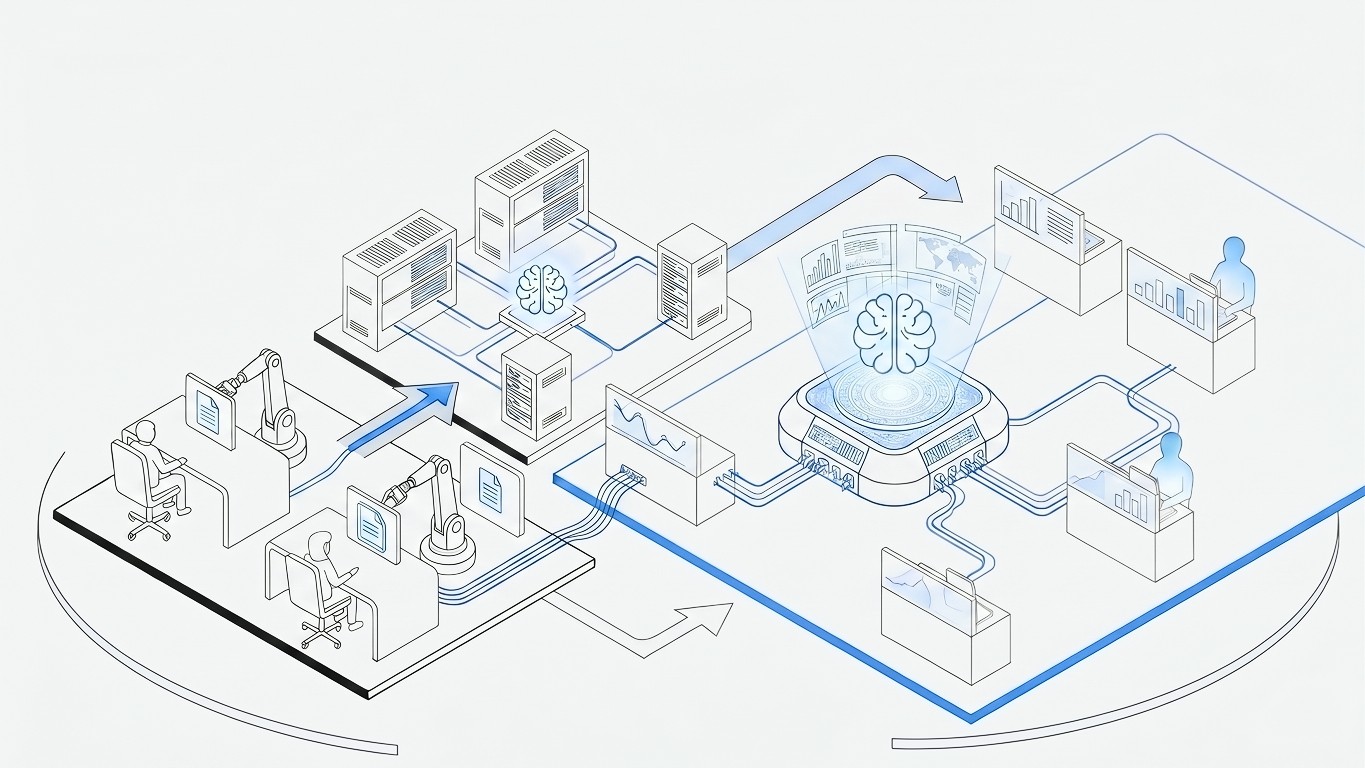
AI in BPM is not a single technology. It is a layer of capability that runs across the entire delivery model, changing how processes are monitored, how decisions are made, how quality is assured, and how performance improves over time.
In practical terms, AI in BPM operating today inside leading business process management services providers includes:
Automated quality monitoring. Every interaction reviewed, scored, and flagged without a human QA analyst listening to every call. Issues surface faster. Coaching happens sooner. Quality consistency improves across the floor, not just in sampled interactions.
Real-time agent assist. AI surfaces relevant information, suggested responses, and compliance guidance to agents during live interactions. Handling time drops. First-call resolution rates improve. New agents perform closer to experienced ones from their first week.
Sentiment intelligence. Conversation analysis tools that read tone, urgency, and emotional signals in real time, allowing supervisors to intervene before an interaction deteriorates and allowing managers to identify systemic frustration patterns across thousands of calls simultaneously.
Conversational AI and virtual agents. Handling routine, high-volume interactions at scale, freeing human agents for complex, high-value, or emotionally sensitive conversations that genuinely require human judgment.
Predictive analytics. Using interaction history, behavioural signals, and operational data to anticipate what a customer needs, when churn risk is rising, or when a collections account is most likely to respond. Decisions become proactive rather than reactive.
Process automation. Eliminating manual, repetitive back-office tasks through robotic process automation, reducing error rates, accelerating throughput, and removing the human bottleneck from high-volume transactional work.
How digital transformation is reshaping business process management services
Digital transformation in the context of business process management services is not about replacing the workforce with technology. It is about fundamentally redesigning what the workforce does and how the surrounding systems support them.
The most advanced business process management services providers are moving towards a model where:
Technology handles volume. Human expertise handles complexity. Analytics drives continuous improvement. And the operating model as a whole gets measurably better every quarter, not just more efficient at the same level of performance.
This is a structural change. Automation services handle the repeatable. AI handles the analytical. People handle the relational. Each layer does what it is genuinely best at, rather than compensating for the limitations of the others.
The impact on enterprise outcomes
The shift towards AI-powered business process management services is not theoretical. The outcome data from enterprises that have made this transition is already clear.
Quality consistency improves significantly when every interaction is monitored rather than a sample. First-call resolution rates rise when agents have real-time information support. Customer satisfaction scores improve when sentiment signals are acted on before issues escalate. Operational costs reduce as automation services absorb transactional volume. And the improvement is not a one-time step change. It compounds over time as the AI layer learns from more data and the human layer focuses on increasingly complex, high-value work.
The talent implication inside business process management services
One of the less-discussed consequences of AI in BPM is what it does to the talent profile required on the floor. As automation services absorb routine tasks, the work that remains for human agents becomes more complex, more nuanced, and more consequential.
This means business process management services providers must invest in a different kind of talent development. Agents need stronger emotional intelligence, better problem-solving capability, and deeper domain knowledge. Training models need to evolve alongside the technology. And workforce management needs to account for a delivery model where human capacity and AI capacity are planned together, not separately.
The enterprises whose business process management services partners are already building this capability will have a meaningful edge in customer experience quality over the next three to five years.
The role of digital transformation in long-term competitiveness
For enterprise leaders, digital transformation inside business process management services is not just an operational improvement agenda. It is a competitive positioning decision.
Customer expectations are rising. Tolerance for slow, inconsistent, or impersonal service is falling. The enterprises that can deliver fast, accurate, empathetic, and personalized experiences at scale will retain customers at higher rates, acquire new ones more efficiently, and build brand equity that is genuinely difficult to replicate.
AI in BPM is the engine that makes that possible at scale. And the right business process management services partner is the delivery mechanism that turns the engine into outcomes.
What to look for in an AI-ready business process management services partner
Not every business process management services provider has made the investment in AI in BPM at the depth that enterprise-scale delivery requires. When evaluating partners for digital transformation readiness, the questions that matter most are:
Do they own their AI and automation services platforms, or are they reselling third-party tools with limited customisation capability?
Can they demonstrate measurable outcomes from existing AI deployments, not just capability demonstrations?
How do their quality monitoring, agent assist, and analytics tools work together as an integrated system rather than disconnected point solutions?
What is their model for continuous improvement, and how does the AI layer contribute to it over time?
How do they manage the talent transition as automation services absorb more transactional volume?
The bottom line
The future of business process management services is not about choosing between people and technology. It is about building a delivery model where both operate at their highest potential, connected by an AI layer that makes the whole system smarter, faster, and more responsive over time.
Digital transformation in business process management services is already delivering measurable outcomes for enterprises that have moved early. For those still evaluating, the question is not whether to move. It is how quickly, and with which partner.
The right business process management services provider brings the AI capability, the automation services infrastructure, and the human expertise to make that transition at enterprise scale, without disruption, and with measurable results from the start.
Learn how AI-driven BPM can transform operations
Find out how BPOC's AI-powered business process management services and automation services can help your enterprise move faster, perform better, and deliver exceptional customer experiences at scale. Write to info@bpoconvergence.com to start the conversation.
" transform="translate(14.43 5.93)" width="6.07px"/><path d="M 0 0 L 16.83 0" fill="transparent" height="1px" id="MMjyZF7WG" stroke-dasharray="" stroke-linecap="round" stroke-linejoin="round" stroke-width="1.5" stroke="rgb(255, 255, 255)" transform="translate(3.5 12)" width="16.83px"/></svg>)