
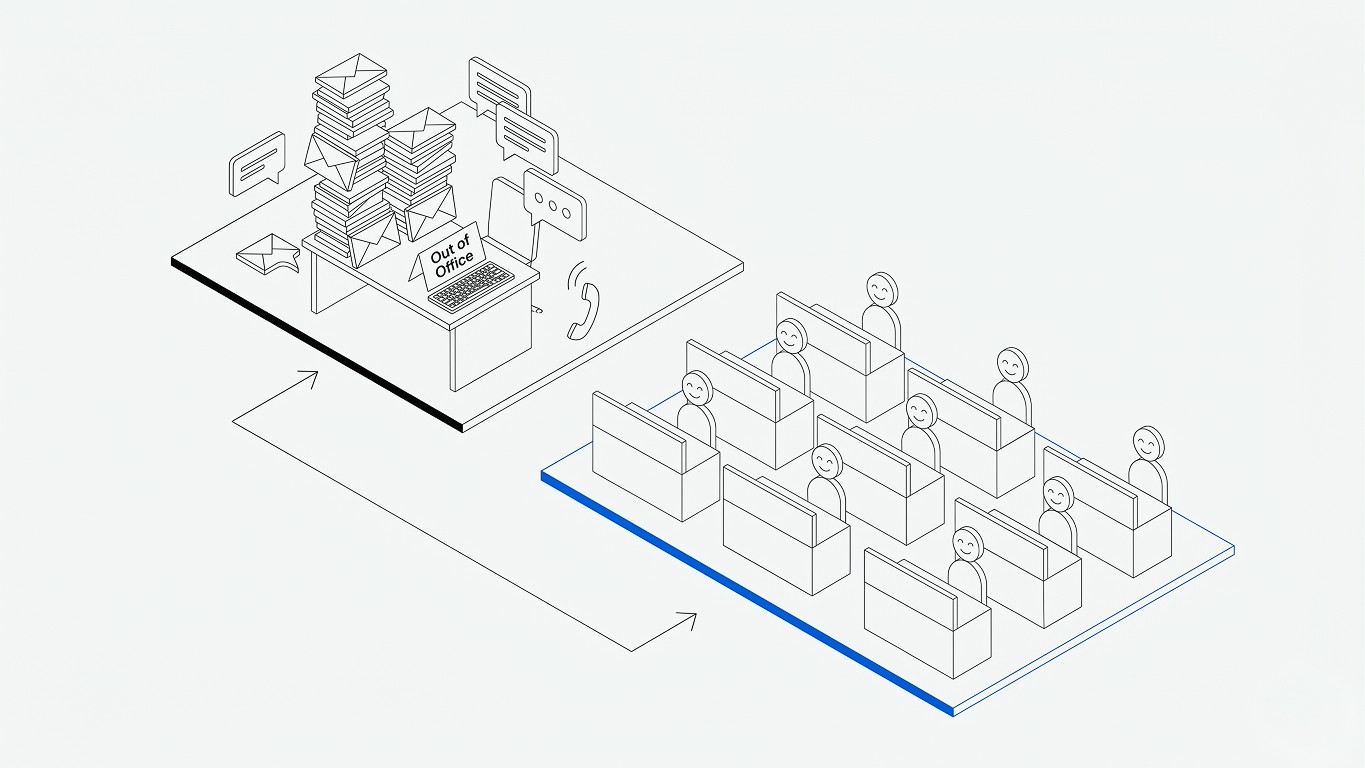
Sign 1: Response times are rising and customers are noticing
When average handle time climbs, queues lengthen, and first-response SLAs start slipping, the root cause is almost always the same. The volume of customer contacts has outgrown the capacity of the team built to handle them.
In-house teams can absorb short-term spikes with overtime and redeployment. But when elevated response times become the baseline rather than the exception, the team is structurally under-resourced and the customer experience is paying the price.
A customer support outsourcing company with elastic capacity solves this structurally, not temporarily. Additional trained associates, already embedded in proven delivery systems, absorb the volume without the lag of a full recruitment cycle.
Sign 2: Quality is inconsistent across agents and shifts
Consistent customer experience management services require consistent delivery across every agent, every shift, every channel. When quality scores vary significantly depending on who picks up the call or which team is on shift, the problem is not individual performance. It is a structural gap in training, quality assurance, and performance management.
A mature customer support outsourcing company runs quality as a system, not an afterthought. Structured training engines, regular calibration, automated quality monitoring, and clear performance frameworks produce consistency that in-house teams with high attrition and stretched management rarely sustain.
Sign 3: Attrition is constantly disrupting the team
Customer support roles carry some of the highest attrition rates in any industry. Every departure means recruitment costs, a training period where the new hire is not yet fully effective, and a temporary drop in the quality and speed of service.
When attrition becomes a continuous cycle rather than an occasional disruption, the in-house model is absorbing enormous cost and management energy just to stand still. Outsourced support transfers that burden entirely. Recruitment, training, and attrition management sit on the provider's cost base. The enterprise receives consistent output without the constant disruption of a revolving team.
Sign 4: Scaling up for peaks is slow, expensive, and stressful
Seasonal demand spikes, product launches, promotional campaigns. Each one requires a burst of customer support capacity that the in-house team cannot absorb without significant advance planning, recruitment, and training investment.
When scaling up takes months and scaling back down leaves the business carrying excess capacity, the operating model is structurally misaligned with the demand profile. A customer support outsourcing company with agile sourcing capability and prebuilt training engines can ramp capacity in weeks, not quarters, and flex it back down just as quickly when demand normalises.
Sign 5: Your team is delivering support but not insights
A high-performing customer support outsourcing company does more than resolve customer queries. It captures, analyses, and surfaces the patterns inside those queries, feeding insight back into product, operations, and leadership.
When in-house support teams are too stretched to do anything beyond transaction handling, the business loses access to one of its richest sources of customer intelligence. Complaint patterns, recurring friction points, emerging dissatisfaction signals, all of it sits in the interaction data, unread and unactioned.
Customer experience management services delivered by a capable outsourcing partner include the analytics layer that turns support volume into operational and strategic intelligence.
Sign 6: Multichannel delivery is fragmented and inconsistent
Customers today expect support across voice, email, chat, social media, and messaging platforms, with a consistent experience regardless of which channel they use. When different channels are managed by different teams with different training, different tools, and different quality standards, the fragmentation is obvious to customers even when it is invisible to the business.
Building a genuinely integrated omnichannel customer experience management services capability in-house requires significant investment in technology, process design, and workforce management. A customer support outsourcing company with omnichannel delivery infrastructure already in place eliminates that investment and delivers consistency from day one.
Sign 7: Leadership is spending too much time managing support operations
When customer support issues regularly reach the CXO, COO, or CEO level, it is a signal that the operation lacks the governance and management depth to contain and resolve problems at the right level.
Senior leaders should not be routinely involved in support escalations, agent management, or operational troubleshooting. That is the day job of a delivery partner with a clear management structure and a mature escalation framework.
Outsourced support managed by a capable customer support outsourcing company moves those conversations down the chain where they belong, freeing leadership to focus on strategy, growth, and the decisions that only they can make.
What to look for in a customer support outsourcing company?
Recognising the signs is the first step. Choosing the right partner is the next. When evaluating a customer support outsourcing company for outsourced support at enterprise scale, the factors that determine long-term success include:
Omnichannel capability. Can the provider deliver consistent customer experience management services across voice, digital, and messaging channels from a single integrated model?
Domain expertise. Does the provider understand the specific customer journeys, regulatory context, and service expectations of your industry?
Quality infrastructure. How are performance standards set, monitored, and improved? What is the track record on CSAT, NPS, and first-call resolution across comparable client engagements?
Scalability. Can the provider ramp up and down in line with your demand profile without significant lead time or quality compromise?
Analytics and insight delivery. Does the customer support outsourcing company surface actionable intelligence from interaction data, or simply report activity metrics?
Commercial model. Is the provider willing to be held accountable for outcomes, not just outputs?
The cost of waiting
Every month a business delays moving to outsourced support when the signs are already visible is a month of rising costs, declining customer satisfaction, and management bandwidth being absorbed by an operation that a specialist partner could run better.
The businesses that move early gain a structural advantage in customer retention, operational efficiency, and leadership focus. The ones that wait typically move when something breaks, and by then the cost of transition is higher and the damage to customer relationships is already done.
The bottom line
The seven signs covered in this blog are not isolated problems. They are symptoms of a single underlying issue: an in-house customer support model that has reached the limits of what it was built to do.
A capable customer support outsourcing company does not just solve the operational problem. It delivers a step change in customer experience management services quality, consistency, and intelligence that in-house teams at the same cost level simply cannot match.
About BPOC, a Fornax Group company
BPOC (BPO Convergence) is a leading customer support outsourcing company delivering customer experience management services across voice, digital, and omnichannel platforms for enterprises in BFSI, e-commerce, telecom, healthcare, and automotive. With 20+ years of trust, 5,000+ trained associates, 11 delivery centres, and 22 languages, BPOC brings the scale, quality infrastructure, and domain expertise that enterprise outsourced support demands.
BPOC is part of Fornax Corporate Services Pvt. Ltd., a digitally enabled business services platform headquartered in Bengaluru and backed by Carpediem Capital Partners. Founded in 2020 by industry veteran Subrata Nag and operational since June 2022, Fornax now serves 700+ clients across India, the USA, and the UK through a workforce of 37,000+. Its group companies span HR services, IT staffing, customer experience management, revenue cycle management, and finance and accounting.
For clients, that means outsourced support backed by the financial strength and ecosystem of a well-capitalised group, with the specialist depth of a dedicated customer support outsourcing company.
Improve your customer support operations
Find out how BPOC's customer experience management services can help your business deliver faster, more consistent, and more intelligent outsourced support at every stage of the customer journey. Write to info@bpoconvergence.com to start the conversation.
" transform="translate(14.43 5.93)" width="6.07px"/><path d="M 0 0 L 16.83 0" fill="transparent" height="1px" id="MMjyZF7WG" stroke-dasharray="" stroke-linecap="round" stroke-linejoin="round" stroke-width="1.5" stroke="rgb(255, 255, 255)" transform="translate(3.5 12)" width="16.83px"/></svg>)